Despite the dominance of SMD technology in modern electronics, through-hole components have not disappeared — and will not. Connectors that must withstand the mechanical forces of repeated mating and unmating, transformers and inductors with ferrite cores, higher-capacitance electrolytic capacitors, relays, fuses, terminal blocks — all of these are components that for functional or mechanical reasons come in through-hole form and require reliable, precise manual soldering.
PTH soldering is carried out on Weller soldering stations — the industry standard for precise manual soldering. The key advantage of Weller stations is precise and stable temperature control at the tip. Temperature is not an approximation — it is a defined value held constant regardless of how much heat flows into the joint. That is the difference between a reliable joint and one that looks clean but conceals a cold zone inside that will eventually manifest as an intermittent fault.
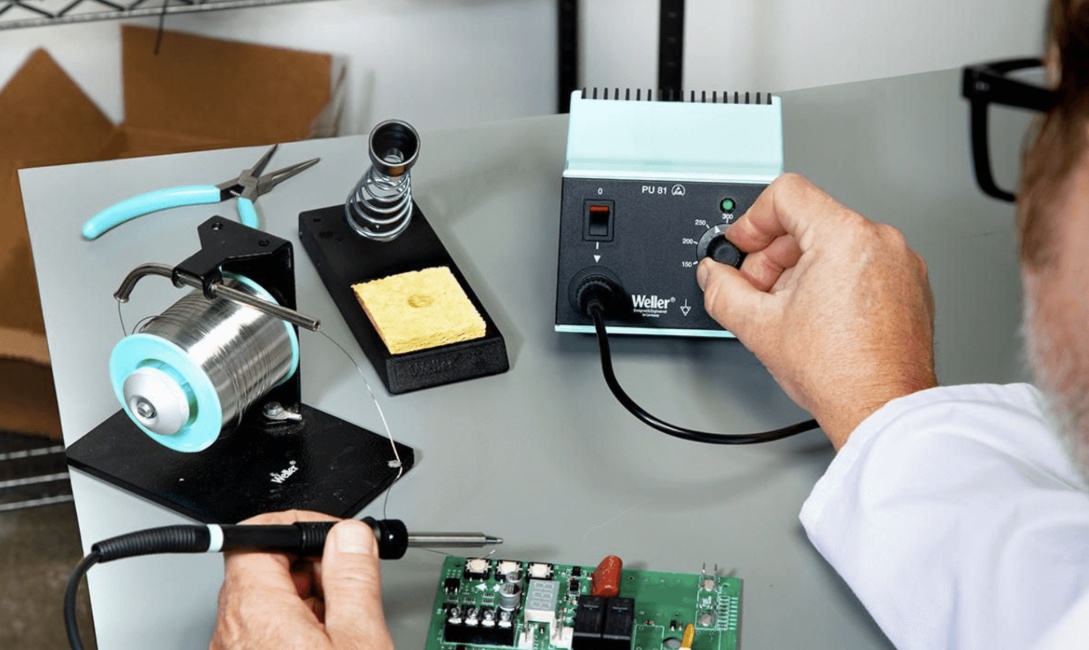
Every through-hole joint requires the right balance of heat, time and solder quantity. Too little temperature or too short a dwell time and the flux does not activate sufficiently — the result is a cold or grainy joint with poor mechanical strength. Too much heat or too long a dwell and thermal damage to the component, pad lifting or PCB delamination in the joint zone can occur. An experienced technician balances this intuitively, but grounded in knowledge of materials and joint behaviour.
For removing incorrectly placed components or reworking joints we use Weller vacuum desoldering stations. Vacuum desoldering allows clean and controlled solder removal from through-hole apertures without mechanical stress on the PCB or surrounding components — which is particularly important on multilayer boards where a through-hole via passes through multiple inner layers.
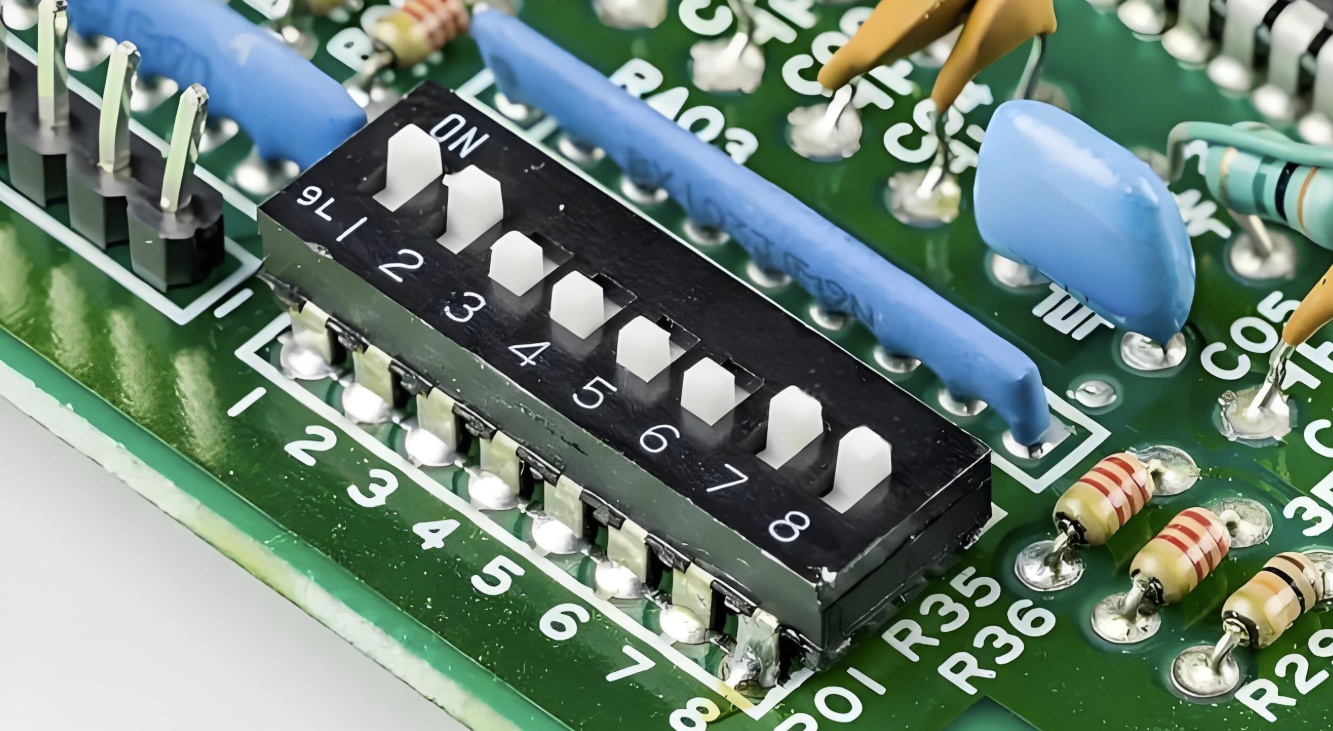
After PTH soldering every board undergoes visual inspection of joints under the stereo microscope. A good through-hole joint has a characteristic appearance — solder has flowed evenly into the aperture from both sides of the board, formed a concave meniscus around the pin, and the boundary between solder and copper pad is clearly visible. Anything that deviates from that appearance — a convex joint, incomplete aperture fill, a cold or grainy joint — is reworked before the board leaves the workbench.
Mixed boards — combining SMD and PTH components — typically pass through the reflow oven with SMD components already assembled, and PTH components are mounted and soldered afterwards. The sequence matters: PTH assembly goes last because the high temperatures of reflow would not be acceptable for many through-hole components, and handling the board while inserting PTH components must not damage the already-soldered SMD parts.