Every project that leaves our facility is accompanied by complete technical documentation. This is not a formality or an addition prepared at the end — documentation is created in parallel with the project, step by step, and accurately reflects what was done, why and how. A client who receives a device from us also receives the knowledge needed to operate that device, reproduce it and develop it further — regardless of whether they do so with us or with someone else.
Bill of Materials (BOM)
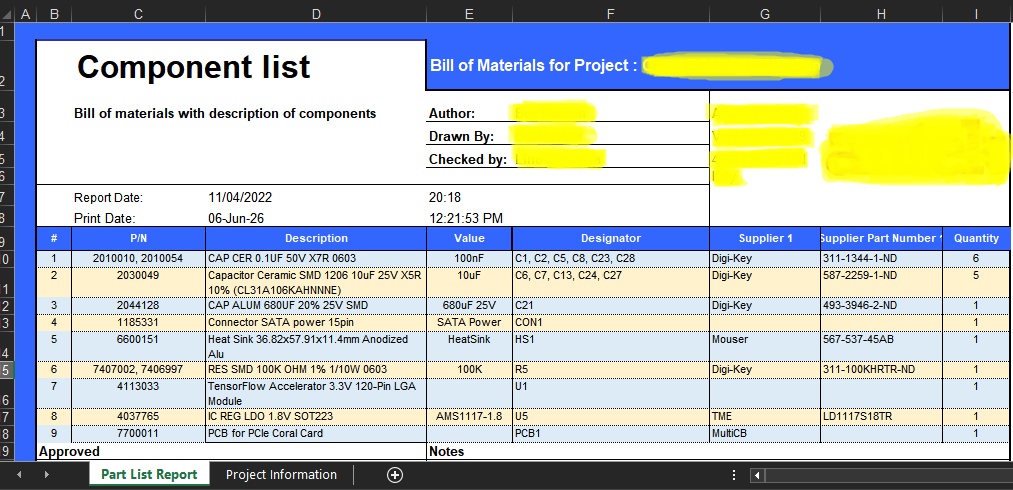
The BOM is a list of every component in the design — with the precise manufacturer MPN, schematic reference, quantity, package and recommended distributor. It is not just an ordering list; it is a reference document that unambiguously defines every part of the device. For every key component we include verified alternates — replacement parts that are pin-compatible or functionally equivalent — because a BOM that depends on a single source of supply is not resilient to the reality of the component market.
We deliver the BOM in a structured Excel format that can be used directly for ordering from distributors, for series cost calculation and for inventory management. Every new design revision brings a new BOM revision, with changes clearly marked.
PCB specifications
The PCB specification document describes all parameters of the printed circuit board needed for ordering fabrication: number of layers, material, thickness, stackup, surface finish (HASL, ENIG, OSP...), solder mask colour, minimum trace widths and clearances, via specifications, controlled impedance where applicable, and all other requirements the fabrication house must meet. Gerber files, drill files and assembly drawing are included alongside the specification and together form a complete fabrication package that can be sent to any PCB manufacturer in the world.
Mechanical drawings
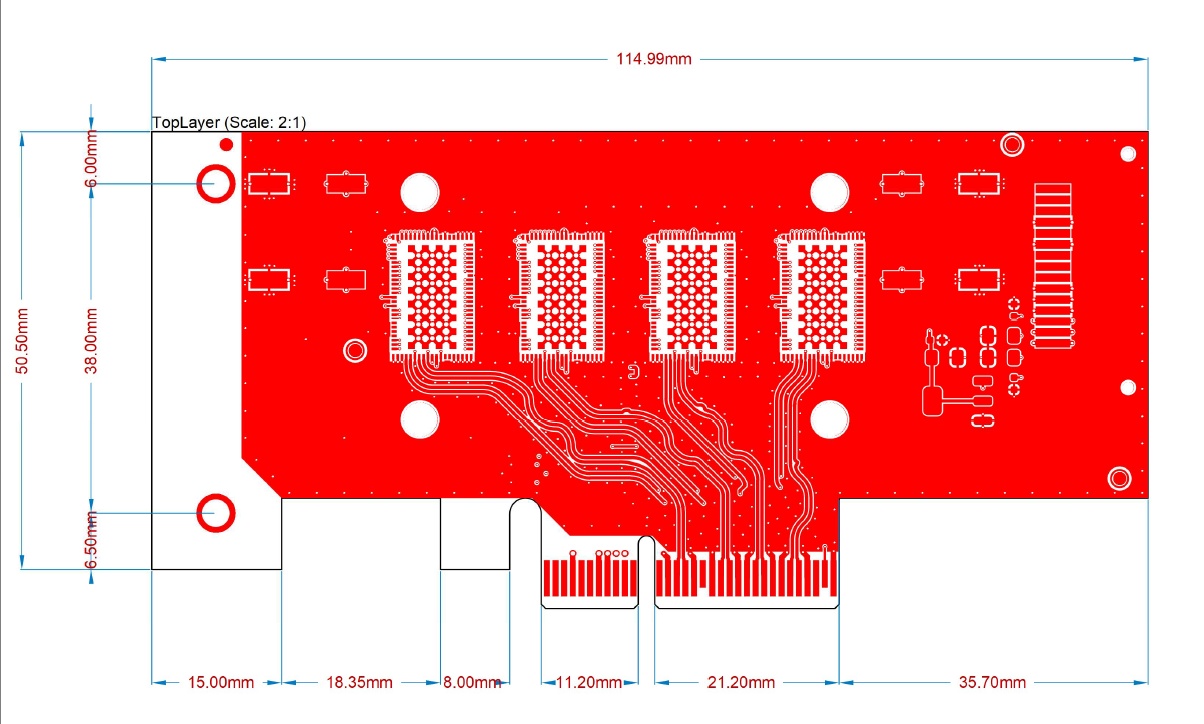
For projects that include an enclosure or mechanical integration into a larger system we produce mechanical drawings in standard formats. The drawings define board dimensions, mounting hole positions, component heights, connector and aperture positions on the enclosure, and tolerances for critical dimensions. A client who wants to order an enclosure from another supplier, integrate the device into their own mechanical construction or verify fit within an existing space — all of that can be done with the documentation we have delivered, without re-measurement or guesswork.
Production instructions
The production document describes the entire device assembly process step by step — assembly sequence, special handling requirements for individual components, soldering parameters, wiring and connector assembly instructions, and everything a technician needs to know to assemble the device correctly and consistently. Well-written production instructions are critical when a series scales or when a new technician joins the process — because procedures that exist only in someone's head are not procedures, they are a risk.
Programming instructions
The programming document describes all steps needed to program the device — which programmer to use, which interface, which firmware version, how to verify that programming has completed successfully. For devices with an operating system we also document the installation procedure, software stack component versions and all configurations applied. The goal is for any technician with the documentation in hand to be able to program the device identically — without knowledge of the internal system architecture and without improvisation.
Testing instructions
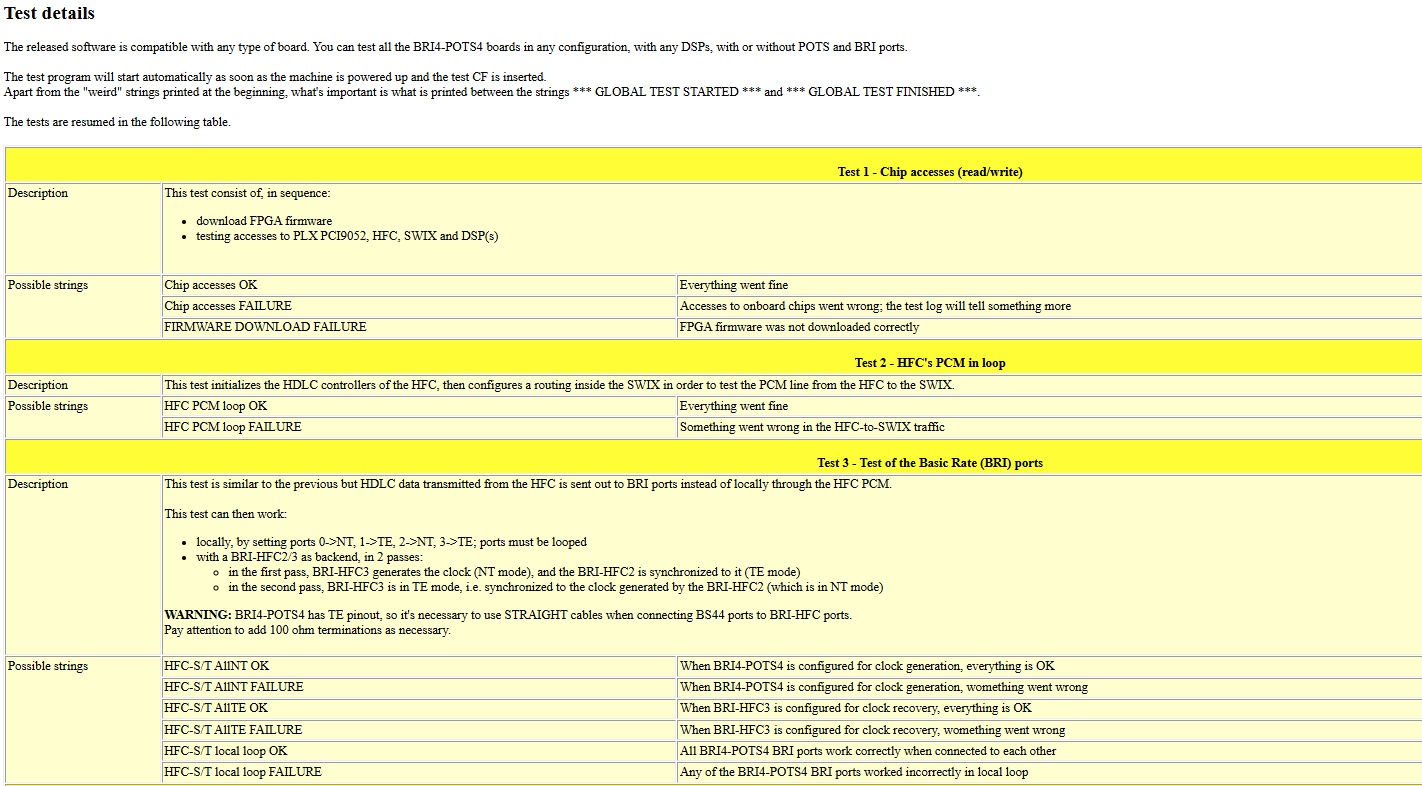
The test document defines what is tested, in what sequence, with what equipment and what acceptable results look like. Every step has a clearly defined pass criterion — it is not enough to write "measure voltage at TP3", it needs to say "measure voltage at TP3, acceptable range 4.9 V – 5.1 V, anything outside this range send to rework". Test instructions precise enough to be carried out by a technician with no prior project knowledge — that is the level of precision we aim for.
Documentation as long-term value
Technical documentation has a value that extends far beyond the moment of delivery. A year after the device is in production, a client who wants to order a new series, introduce a design change or move production to another supplier — can do so because they have the documentation. Without it, every such change starts from scratch. That is precisely why we do not treat documentation as a closing administrative step but as an integral part of what we deliver.