An assembled and soldered board is not yet a finished device. The two steps that make it functional — programming and testing — are equally important as every step before them, and equally demand experience and attention. A device that has not been correctly programmed or tested is not a product; it is an expensive collection of components waiting for a problem to emerge.
Programming
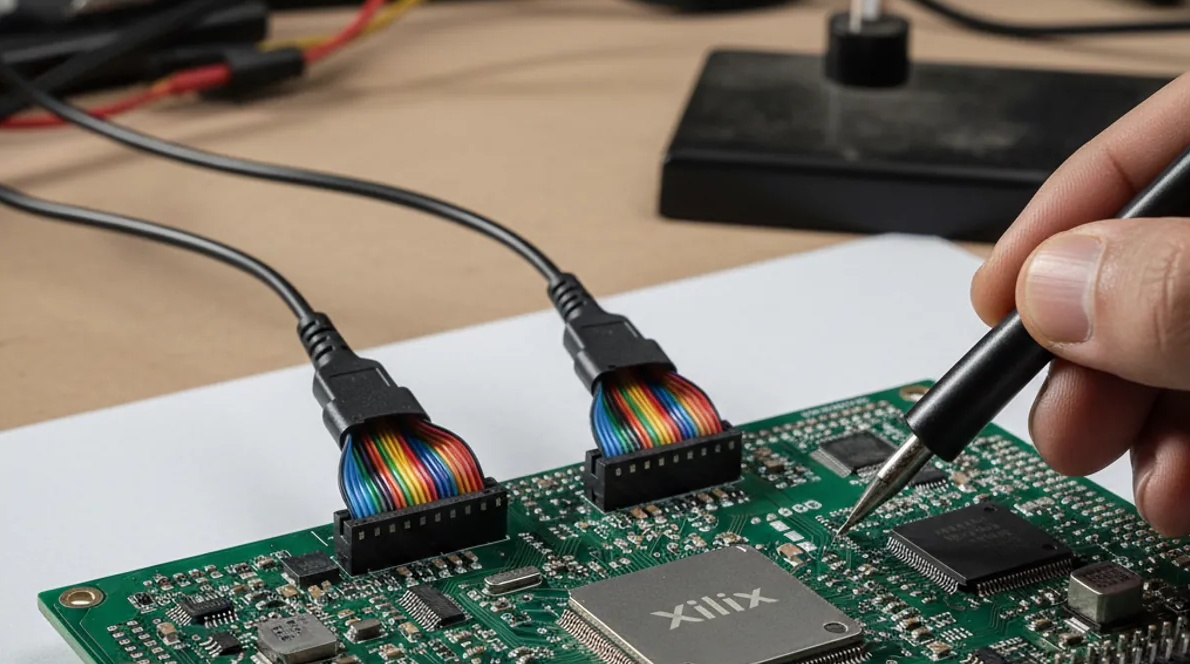
Programming covers everything needed for the device to receive its software and configuration. For microcontrollers and processors this means flashing firmware through the appropriate programming interface — JTAG, SWD, UART bootloader or an architecture-specific programmer. For FPGAs and CPLDs it means loading the bitstream that defines the logical structure of the programmable device. Each of these processes has its own requirements and its own methods of verifying that programming has completed successfully.
For devices running an operating system — Linux, RTOS or otherwise — OS installation is part of the programming process. Depending on the platform, this can mean writing an image to a microSD card, programming an eMMC memory chip directly on the board, or initialising NOR/NAND flash memory with a bootloader and partitions. For series production we develop procedures that ensure every device leaving the facility has an identical, verified software configuration — without manual steps that introduce the possibility of error.
Prototype testing
Prototype testing is a distinct discipline that differs from series testing. A prototype comes without guarantees — it is the first physical instance of a design that has not yet passed any validation. Every prototype is treated with appropriate caution.
Before a prototype receives power at all, we visually inspect the assembly in critical zones — voltage regulators, protection circuits, electrolytic capacitor polarity. Only after that check is power introduced gradually and under control. We measure voltage rails — are all voltage domains at the correct voltage, are there unexpected drops indicating a short circuit or overload. We measure total current consumption and compare it against the estimate from the design phase. Any deviation from expected consumption always says something — sometimes something benign, sometimes something that needs resolving before proceeding.
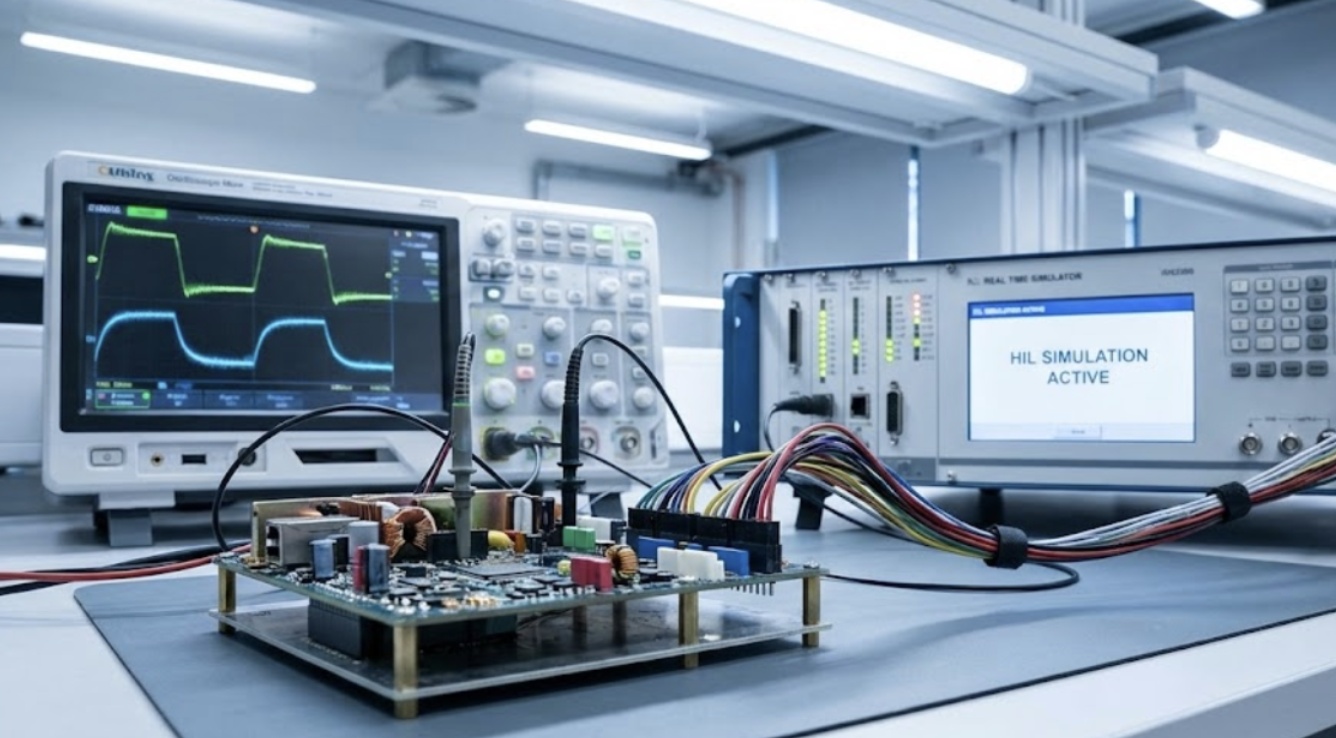
Once power is verified, programming and functional testing follow. We use an oscilloscope to monitor signals at key points — clock signal, communication interfaces, PWM outputs, analogue signals. A signal generator stimulates inputs and we verify that the device responds as expected. If the device has a video output, it is connected to a monitor. If it has USB, Ethernet or serial communication, those links are tested. Every functional block of the device goes through its own verification before we conclude that the prototype is working correctly.
Series testing
Testing in series production must be fast, repeatable and reliable. For every project we define a test protocol covering the key functions of the device that can be executed consistently on every unit without depending on the judgement of an individual technician. The clearer and more precise the test protocol, the lower the risk of a defective device passing through the net.
Stress testing
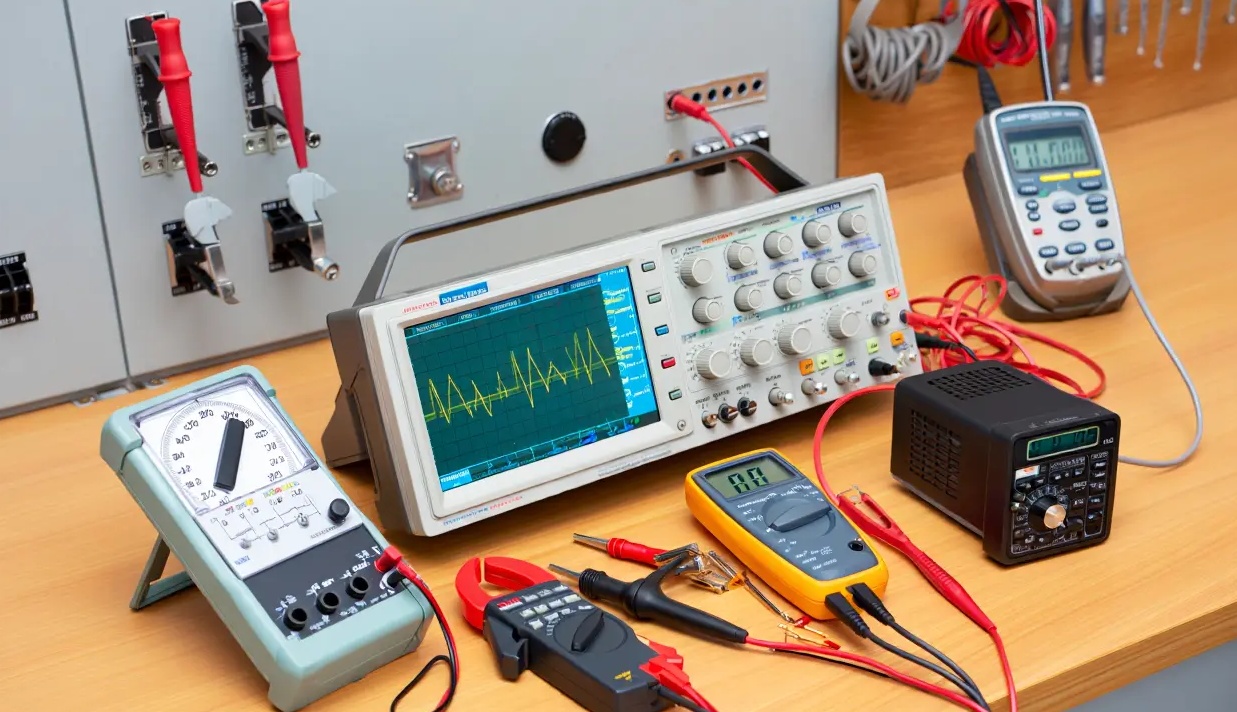
For devices where reliability is critical — industrial applications, outdoor conditions, continuous operation — we carry out hardware stress testing. The device is run at full load for a defined period of time, during which we monitor temperature, current consumption and functional parameters. The goal is to provoke all potential weaknesses — thermal, electrical, mechanical — under controlled conditions in the facility, not at the end user's site in the field.
A device that survives stress testing in our facility has a high probability of having no surprises in real-world use. That is not an unconditional guarantee — but it is as close as can be achieved without certification laboratories and year-long soak tests.